
Updated September 2026
King David’s family tree stretches from Ruth and Boaz through the kings of Judah and ultimately to Jesus Christ. But reconstructing David’s immediate family is not always straightforward. Samuel and Chronicles sometimes omit names, use alternate names, or preserve different details about the same person.
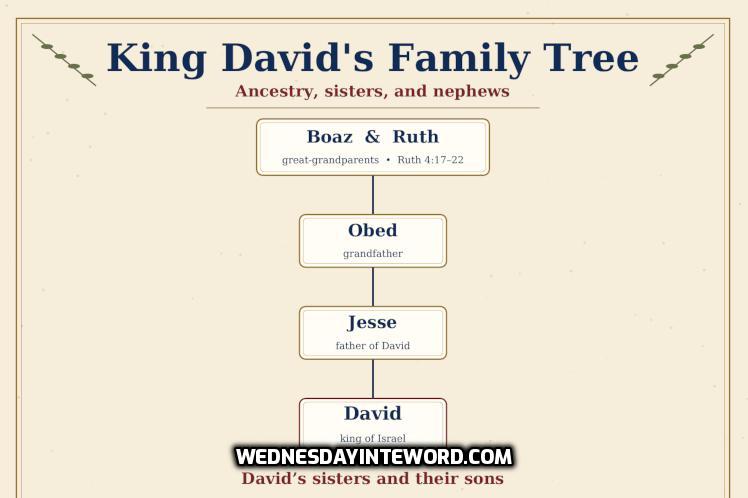
The chart below brings those passages together into one probable reconstruction.
Download a free PDF of David's Family Tree Chart
Why do Accounts of David’s Family Differ?
The principal descriptions of David’s family appear in Ruth 4:17–22; 1 Samuel 16–17; 2 Samuel 3:2–5; 5:13–16; and 1 Chronicles 2:9–17; 3:1–9; 14:3–7. When we compare these passages, several apparent differences emerge.
Genealogies sometimes omit people
Biblical genealogies were often selective. Their purpose was to establish family descent, inheritance, or royal succession, not necessarily to name every person in every generation.
For example, 1 Samuel 16:10–11 and 17:12 describe Jesse as having eight sons, with David as the youngest. But 1 Chronicles 2:13–15 names only seven sons and calls David the seventh.
Most likely, Chronicles omits one of David’s brothers, perhaps because that brother died without leaving descendants. Scripture does not give us enough information to identify him with certainty.
The same person may be known by different names
Several members of David’s family appear under alternate names:
| Name in one passage | Name elsewhere | Identification |
|---|---|---|
| Shammah | Shimea | David’s brother |
| Chileab | Daniel | David’s second son |
| Bathsheba | Bath-shua | David’s wife and Solomon’s mother |
| Shammua | Shimea | One of Bathsheba’s sons |
| Eliada | Beeliada | One of David’s sons |
Such variations may reflect alternate names, differences in spelling, or the way Hebrew names were rendered in English.
Some names occur more than once
David apparently gave more than one son the same name. 1 Chronicles 3:6–8 lists two sons named Elishama and two named Eliphelet.
It is also possible that a name was given again after an earlier child died, but Scripture does not explain why the names were repeated.
Who was Nahash?
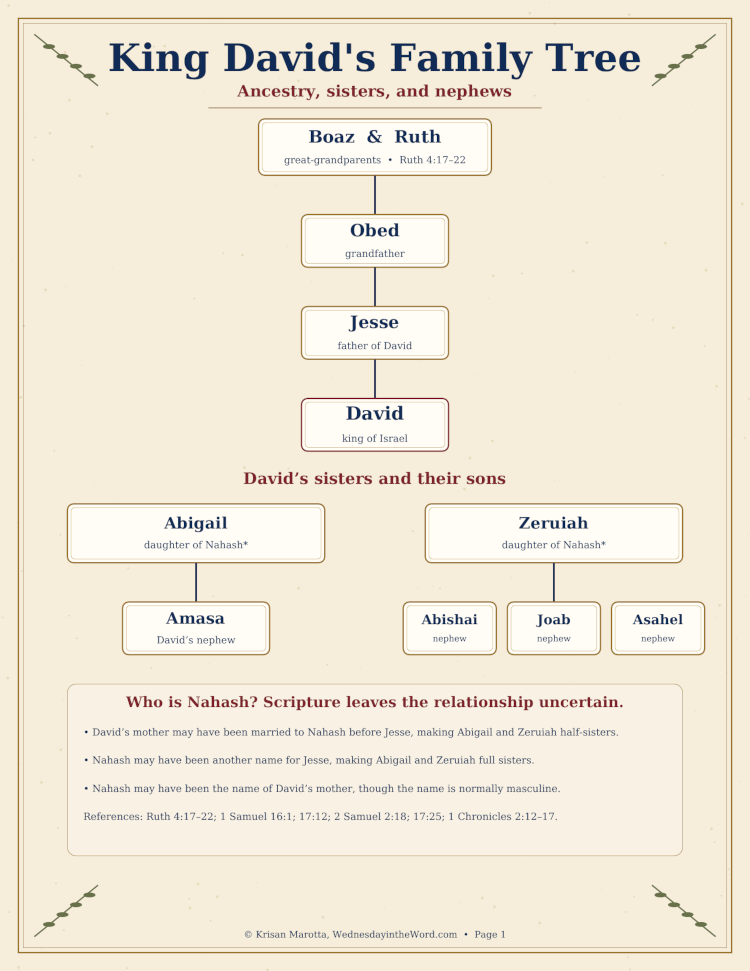
1 Chronicles 2:16 identifies Zeruiah and Abigail as David’s sisters and therefore daughters of Jesse. But 2 Samuel 17:25 calls Abigail “the daughter of Nahash” and the sister of Zeruiah.
Several explanations have been proposed:
- Nahash may have been another name for Jesse.
- David’s mother may have been married to Nahash before she married Jesse, making Abigail and Zeruiah David’s half-sisters.
- Nahash may have been the name of David’s mother, although it is normally a masculine name.
- The wording may preserve a family relationship that is no longer clear to us.
The safest conclusion is that Zeruiah and Abigail were David’s sisters or half-sisters. Scripture does not allow us to determine the exact relationship with certainty.
Did Michal Have Children?
2 Samuel 6:23 says that Michal had no child until the day of her death. However, the traditional Hebrew text of 2 Samuel 21:8 refers to “the five sons of Michal” born to Adriel.
Some Hebrew manuscripts and ancient translations read Merab rather than Michal in 2 Samuel 21:8. Merab was married to Adriel, while Michal was married to David. For that reason, many modern translations identify the five sons as Merab’s children, possibly raised by Michal.
The family tree follows 2 Samuel 6:23 and shows Michal as having no children of her own.
David's Family Tree
David belonged to the tribe of Judah and descended from Perez, the son of Judah and Tamar.
His immediate ancestry was:
- Great-grandparents: Boaz & Ruth - Ruth 2:1; Ruth 4:17-22; Matthew 1:5
- Grandfather: Obed - Ruth 4:17-22
- Father: Jessie - Ruth 4:17-22; 1 Samuel 16:1; 1 Samuel 17:12
David’s Siblings
1 Chronicles names six of David’s brothers:
- Eliab
- Abinadab
- Shimea, also called Shammah
- Nethanel
- Raddai
- Ozem
- One additional brother whose name is not given in Chronicles
David also had two sisters or half-sisters:
- Zeruiah, the mother of Abishai, Joab, and Asahel, three prominent warriors in David’s kingdom.
- Abigail, the mother of Amasa, who served as a military commander during the rebellions of Absalom and Sheba. She should not be confused with David's wife of the same name.
See 1 Samuel 16:6–13; 17:12–14; 2 Samuel 17:25; and 1 Chronicles 2:13–17.
David’s wives and children born in Hebron
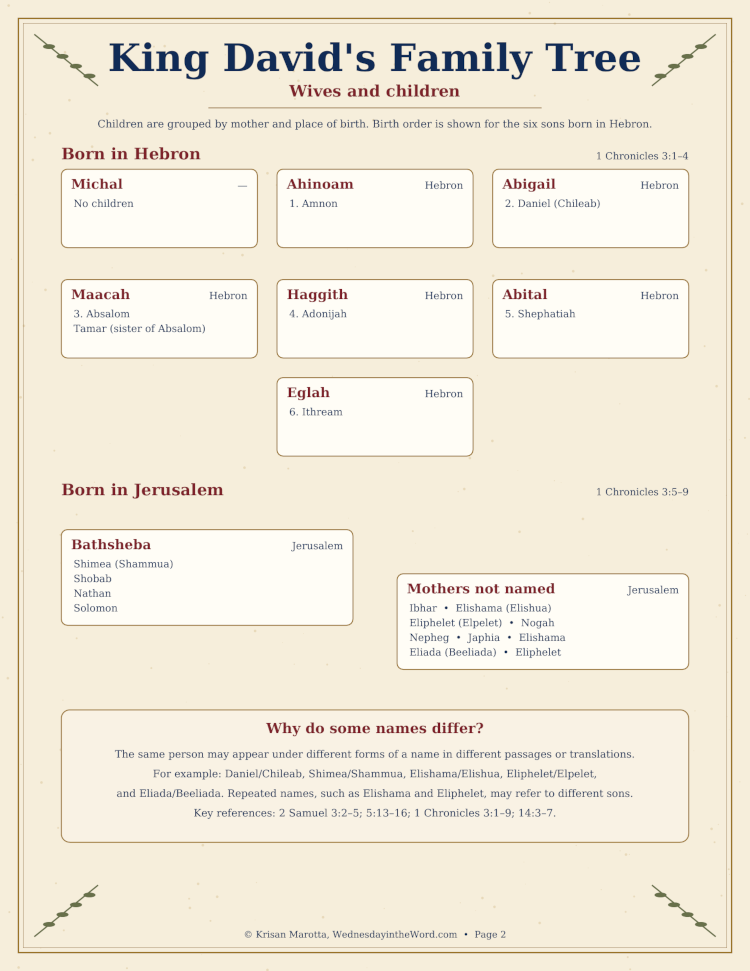
David’s first six sons were born while he ruled Judah from Hebron. Each son had a different mother (2 Samuel 3:2–5; 1 Chronicles 3:1-4)
- Michal - No children
- Ahinoam had Amnon, 1st son
- Abigail had Daniel (Chileab), 2nd son
- Maacah had Absalom 3rd son, and Tamar (Absalom's sister)
- Haggith had Adonijah, 4th son
- Abital had Shephatiah, 5th son
- Egiah had Ithream, 6th son
David’s wives and children born in Jerusalem
After David made Jerusalem his capital, he took additional wives and concubines and had more sons and daughters. These children were born in Jerusalem (1 Chronicles 3:5-9)
- Bathsheba had Shimea (Shammua), Shobab, Nathan, and Solomon.
- Mother unknown: Ibhar; Elishama (Elishua); Eliphelet (Elpelet); Nogah; Nepheg; Japhia; Elishama; Eliada (Beeliada); Eliphelet.
The first child born after David’s adultery with Bathsheba died in infancy and is not named in Scripture (2 Samuel 12:15–23). The four sons listed above were born later.
1 Chronicles 3:9 adds that David also had sons by his concubines and mentions “their sister Tamar.” 2 Samuel 5:13 likewise says that David had additional sons and daughters. Scripture does not give us all their names.
Who’s Who in David’s Family
Zeruiah
Zeruiah was David’s sister or half-sister and the mother of Joab, Abishai, and Asahel. Her sons were among David’s most important warriors. Scripture repeatedly calls them “the sons of Zeruiah,” perhaps because of Zeruiah’s connection to the royal family.
Joab
Joab was David’s nephew and the commander of his army. He was a capable and fiercely loyal soldier, but he repeatedly took justice into his own hands. He killed Abner, Absalom, and Amasa despite David’s wishes. Solomon eventually ordered his execution (2 Samuel 2–3; 18:5–15; 20:8–10; 1 Kings 2:28–34).
Michal
Michal was Saul’s daughter and David’s first wife. She loved David and helped him escape from Saul. Saul later gave her to another man, but David reclaimed her after becoming king. Their marriage ended in estrangement, and Michal had no children of her own (1 Samuel 18:20–28; 19:11–17; 2 Samuel 3:13–16; 6:16–23).
Abigail
Abigail was originally married to Nabal. After Nabal’s death, she became David’s wife. Their son is called Chileab in 2 Samuel and Daniel in 1 Chronicles. Abigail should not be confused with David’s sister of the same name (1 Samuel 25:2–42; 2 Samuel 3:3; 1 Chronicles 3:1).
Bathsheba
Bathsheba was the wife of Uriah the Hittite when David committed adultery with her. After arranging Uriah’s death, David married Bathsheba. Their first child died, but Bathsheba later became the mother of Solomon and helped secure his succession to the throne (2 Samuel 11–12; 1 Kings 1:11–31).
Amnon
Amnon was David’s eldest son and expected heir. He raped his half-sister Tamar. Two years later, Tamar’s brother Absalom arranged Amnon’s murder (2 Samuel 13).
Tamar
Tamar was the daughter of David and Maacah and the full sister of Absalom. Her rape by Amnon exposed the disorder within David’s family and set in motion Absalom’s revenge and rebellion (2 Samuel 13).
Absalom
Absalom was David’s third son. After killing Amnon, he fled to Geshur, his mother’s homeland. He later returned to Jerusalem, rebelled against David, and briefly took control of the capital. Joab killed him despite David’s command that he be spared (2 Samuel 13–18).
Adonijah
Adonijah was David’s fourth son. After the deaths of Amnon and Absalom, he apparently considered himself David’s heir. He attempted to claim the throne while David was still alive, but David appointed Solomon instead (1 Kings 1–2).
Solomon
Solomon was the son of David and Bathsheba. God chose him to succeed David and build the temple in Jerusalem. The royal line continued through Solomon, while Luke’s genealogy of Jesus traces another branch of David’s family through Nathan (2 Samuel 7:12–16; 1 Kings 1–11; Matthew 1:6–16; Luke 3:23–31).
David’s Family and the promised King
David’s family history is filled with faith, courage, betrayal, sexual sin, violence, grief, and political rivalry. Yet God’s promise did not depend on the strength or righteousness of David’s descendants.
God promised David: “Your house and your kingdom shall be made sure forever before me. Your throne shall be established forever” (2 Samuel 7:16).
That promise ultimately points beyond Solomon and the kings of Judah to Jesus Christ, the promised Son of David whose kingdom will never end (Matthew 1:1; Luke 1:32–33).
Further Study:
Saul's Family Tree
Kings of Israel & Judah
Photo by Ivan Diaz on Unsplash
Page Views: 57,325